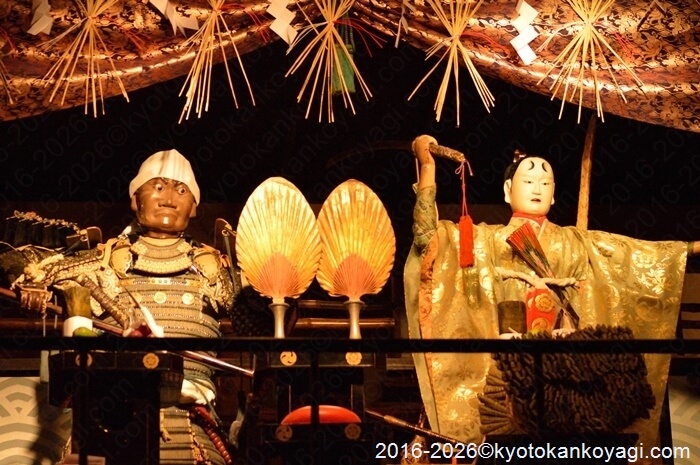
What is Hogan Biiki?
Hogan Biiki (判官贔屓) is a sentiment Japanese people love and it has been passed down from generation to generation without awareness. You’ll find several instances in our cultural inheritance like literature, manga, etc.
The authentic meaning of Hogan Biiki is a compassion for Minamoto no Yoshitsume and it originated sympathy for those who in lower or disadvantaged standing.
“判官(Hogan)” is an official ranking the Imperial Court conferred on him. The word usually pronounced as “Hangan” but we say “Hogan” in the Yoshitsume’s case.
The curious life of Minamoto no Yoshitsune
Vengeance for his father
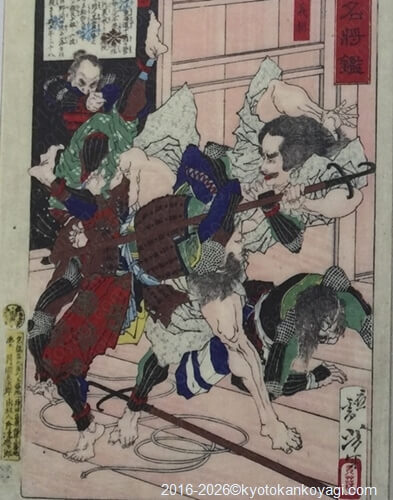
As stated in the previous post, Minamoto no Yoshitsune (源義経) is a historical figure belonged to the Genji (源氏) clan. His father was executed due to a conflict with the Heishi clan (平氏). Yoshitsune was sent to Kurama dera temple and his brother Yoritomo (頼朝) was sent to Izu (Shizuoka prefecture) avoiding the punishment.
Yoshitsune left Kurama dera and temporally stayed in Kyoto where he met Benkei. Benkei joined him and they headed for Hiraizumi (Iwate prefecture).

Check out the previous post, old sport.
On the other hand, the Heishi clan was at the zenith of its political power. A daughter of Taira no Kiyomori, the head of the clan, marry Emperor Takakura and gave birth to a child. He launched a coup and detained the emperor and his grand son enthroned as Emperor Antoku at the age of one.
In 1180, Yoritomo, as the head of the Genji, raised an army against the Heishi clan and Yoshitsune served him as a General.
Five years later, they exterminated the Heishi clan in the battle of Dan no Ura (壇ノ浦の戦い).
In 1185, Yoritomo drove away Yoshitsune though he played the greatest role in the war. We can assume many reasons and the following is the critical ones:
- Yoshitsune was promoted to Hangan without permission of Yoritomo.
- He lost one of the Imperial regalia.
Hogan
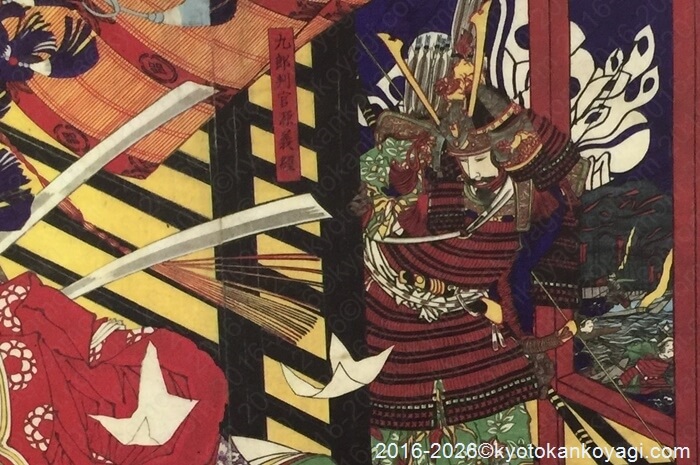
In 1184, Goshirakawa Ho-oh, the retired emperor, confirmed his official ranking 検非違使伊予守従五位下兼行左衛門少尉.
従五位 (Jyu Goi) is a rank of the officials and it is an aide to emperor.
左衛門少尉 (Sae Mon no Shojo) is the third-ranked officer of a ministry of defense of Kyoto. This rank is also called “判官 (Hangan)” but it is ronounced as “Hangan” in this case.
Yoritomo banned to have official ranking but Yoshitsune had it without his permission. For Yoritomo, it seemed to be a treason. He found Yoshitsune betrayed him.
The Imperial regalia and the battle of Dan no Ura
The Imperial ragalia
There are the three Imperial regalia:
- Yata no Kagami (八咫鏡)・・・Mirror
- Yasakani no Magatama(八尺瓊勾玉)・・・Jewels
- Ame no Murakimo no Tsurugi(天叢雲剣)・・・Sword
When Ninigi no Mikoto, the ancestor of Japanese emperor, left Takama no Hara, Amaterasu Ohomikami gave them to him.

The Battle of Dan no Ura
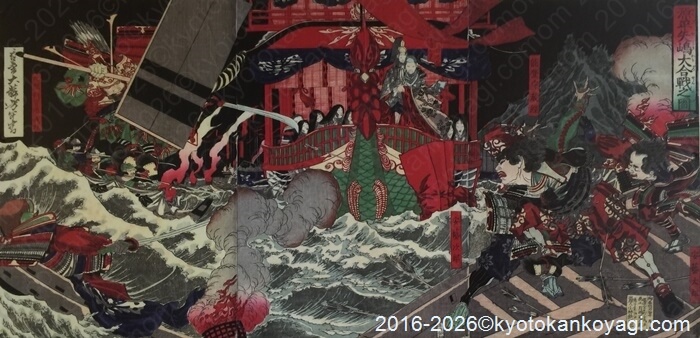
壇ノ浦の戦い
In 1183, Yoritomo ousted the Heishi form Kyoto. The Heishi drifted away on hundreds of boats to Dan no Ura shore. The last stand of the Heishi started. Emperor Antoku and the three Imperial regalia are on the boat in the photo with court ladies.

In Kyoto, Emperor Gotoba had enthroned. There were two emperors.
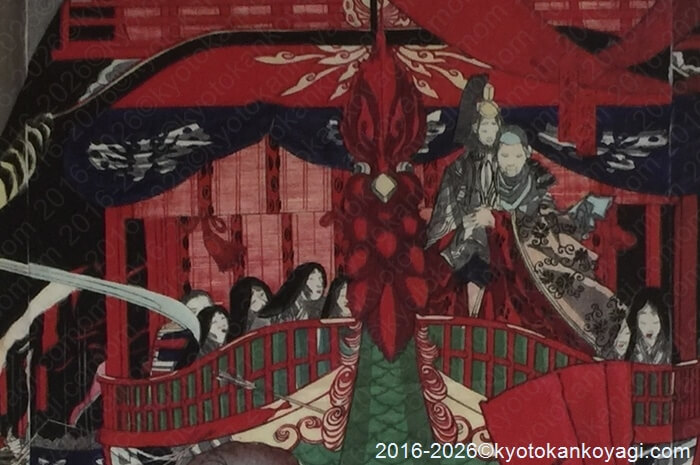
At the end of the battle, the nursing mother of the 6 years old emperor realized a defeat. She took Yasakani no Magatama and Ame no Murakumo no Tsurugi and said, “Shall we go to the Jodo paradise of Amitabha (Buddhist deity). There is another capital under the waves, Your Imperial Majesty.”
Then she threw herself off from the ship, holding the emperor who did Gassho (合掌 The manner of Buddhism. Putting palms together.) in her arms.
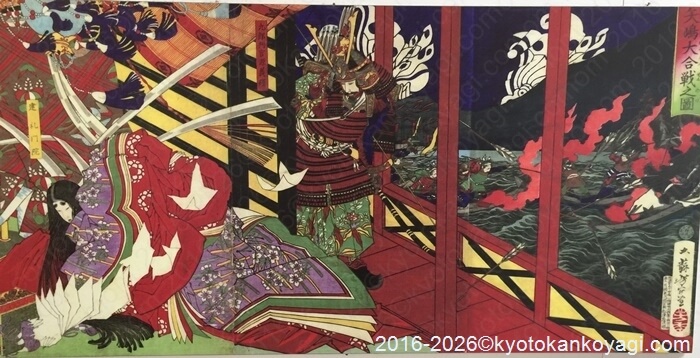
Yasakani no Magatama was in a wooden box and a Samurais of the Genji found it floating round on the sea but they failed to spot the Ame no Murakumo no Tsurugi.
Yoshitsune was in charge of the battle and Yoritomo blamed him though he was able to win the battles without him. He was a leading figure in other battles against the Heishi.
Ame no Murakumo no Tsurugi is enshrined in Atsuta Jingu shrine today. Ise Jingu shrine gave it to the shrine but some say the one lost in Dan no Ura was a replica.
Yoritomo gave the order to execute Yoshitsune
For several reasons, especially those ones, Yoritomo fond Yoshitsune “betrayed” him and gave the order to execute him. Yoshitsune headed for Hiraizumi relaying on the Fujiwara clan there.
In 1189, the 500 troopers of Yoritomo drove Yoshitsune’s callegues (about 15 people) into a small temple of a castle. He realized the end was near and he went into the temple with his wife and daughter. His Rotohs (those who serves someone) guarded the temple and the troopers showered thousands of arrows. Benkei was in front of the entrance and stabbed with them. He ceased to exist, standing upright. Yoshitsune slayed his wife, daughter, and himself in order to save their honor.
Hogan Biiki established
Yoshitsune made a great contribution to the triumph over the Heishi but he was maltreated. His tragic life and misfortune derive sympathy for those who in lower or disadvantaged standing from Japanese people. The word “Hogan Biiki” was established at least by the 17th century. We are so found of him there are several literatures and works of art, etc. The most excessive one is “Yoshitsune-Genghis Khan hypothesis:” Yoshitsune escaped narrowly to Mongol and founded the Mongol empire. It is a ridiculous idea but we want him a happy ending, I suppose. 合掌