THE GIST OF THIS ARTICLE
- Page 1 Who is Oinari-san?, The Deity Enshrined in Fushimi Inari Today, Veneration for Ancestors, Kannnabi, Faith of Dragon and Serpent, Innari no Ohkami: Mixture of Veneration and Faith of Rice Cultivating, Uka no Mitiama and Fox
- Page 2 Oinari-san and Dakini Ten, Dakini Ten, Oinari-san became popular, Goriyaku of Oinari-san, Bibliography
The following is the contents of this article.
- Who is Oinari-san? Uka no Mitama no Kami, Dakini Ten, and Fox 宇迦之御魂神、荼枳尼天、狐さんとは?
- The Deity Enshrined in Fushimi Inari Today 現在の伏見稲荷大社の稲荷大神五柱
- Around 4th to 8th century: Veneration for Ancestors, Kannnabi, Faith of Dragon and Serpent 伏見稲荷の創建以前 祖霊信仰と神奈備・龍蛇信仰
- Innari no Ohkami: Mixture of Veneration and Faith of Rice Cultivating 稲荷大神:秦氏と祖霊信仰・穀霊信仰
- Uka no Mitiama and Fox 宇迦之御魂神とキツネさん
Who is Oinari-san? Uka no Mitama no Kami, Dakini Ten, and Fox 宇迦之御魂神、荼枳尼天、狐さんとは?
Overview

Fushimi Inari Taisha is well-known for its Torii Gates globally but it is a place enshrines “Oinari-san (お稲荷さん)” demestically. Oinari-san is also known as “Inari no Kami,” one of the most popular deities in Japan.
Oinari-san is an ambiguous word due to the complicated religious situation we have: Shinbutsu-Shgo. In this circumstance, Shinto and Buddhist deities had been fused for over 1,600 years. They were separated in the 17th century “in terms of law” but the fusion is still alive.
Who is Oinari-san? There could be various answers and the following is popular ones:
- Uka no Mitama no Kami 宇迦之御魂神・・・Kami (Shinto Deity). The most important Kami enshrined in Fushimi Inari since at least 8th century. As stated later, She is one of Inari no Ohkami(稲荷大神)
- Dakini Ten 荼枳尼天・・・Buddhist Deity in Shingon school. In the fusion of Shinto and Buddhism, she was considered as the same deity as Uka no Mitama no Kami. She was enshrined in Aizenji temple used to be located in Fushimi Inari. Benzaiten (Buddhist Deity) and fox made her fused with Uka no Mitama. In Shin Butsu Shugo, there used to be Buddhist temples in a Shinto shrine, vice versa.
- Fox キツネさん・・・Sinshi (animal serves for Shinto Deity) of Uka no Mitama of Fushimi Inari. She works as a messenger of these deities. People sometimes understand it as Kenzoku (Animal serves for Buddhist Deity) Fusini Inari due to Shinbutsu Shugo. Some shrines/ temples enshrined as deity.
The superordinate
The Deity Enshrined in Fushimi Inari Today 現在の伏見稲荷大社の稲荷大神五柱
The Five Dities 五座相殿
As stated before, Oinari-san is an superordinate. First, I’ll show you Oinari-san enshrined in Fushimi Inari today, then I’ll describe her evolution chronologically.
Fushimi Inari declares that it enshrines “Inari (no) Ohkami(稲荷大神)” consists of five deities: Uka no Mitama no Kami (宇迦之御魂神), Satahiko no Ohkami (佐田彦大神), Ohmiya no Me no Ohkami (大宮能売大神), Tanaka no Ohkami (田中大神), and Shi no Ohkami (四大神). The first three deities has been enshrined since the 8th century and the others were added in 1438.
Uka no Mitama no Kami 宇迦之御魂神
The deity of food and agriculture. Uka implies “Uke,” an ancient Japanese word means food. She is an “Omitama (Spirit) of rice cultivation. She is the most important deity of Fushimi Inari has enshrined since the 8th century. Most of all Inari shrines her. In Shinbustu Shugo, she was regarded as Kannnon. She is a female deity but some pictures belongs to Toji temple depicts her as an old man.
The sources of Japanese mythology tell us who she is.
- Kojiki『古事記』・・・A daughter of Susanoh no Mikoto (素戔嗚尊) and Kmu Ohichi Hime (神太市比売).
- Nihon Shoki『日本書紀』・・・A daughter of Izanagi (伊弉諾神) and Izanaki (伊邪那美).
Sata Hiko no Ohkami 佐田彦大神
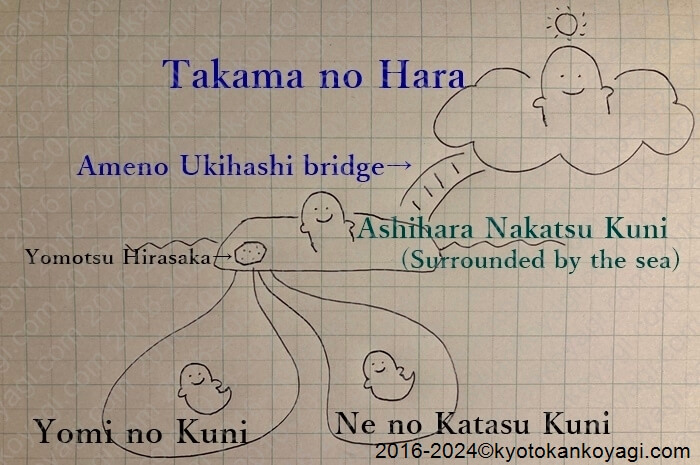
In Japanese mythology, Amaterasu Ohmikami send Ninigi no Mikoto, the ancestor of the emperor, to Ashihara Nakatsu Kuni, or the archipelago known as Japan today. Sata Hiko is a deity who lead Ninigi to Japan. “Sata” is an abbreviated “Sata” that means “Sacred rice paddy.”
Ohmiya no Me no Kami 大宮能比売神
She is a guardian of place. She is a priestess who prepares a food of deities in one view.
Tanaka no Ohkami 田中大神
A deity of rice paddy.
Shi no Ohkami 四大神
A deity of four seasons.
Around 4th to 8th century: Veneration for Ancestors, Kannnabi, Faith of Dragon and Serpent 伏見稲荷の創建以前 祖霊信仰と神奈備・龍蛇信仰
The veneration for ancestors and the faith of Kannnabi 祖霊信仰と神奈備
Before Shinto was organised, there were two primitive belief: The veneration for ancestors (祖霊信仰) and the faith of Kannnabi(神奈備). I’m sure we can find the former in every single society but the latter is indigenous to Japan.
Kannnabi is a belief in places where Kami stays.
Kami is a kind of deity that our ancestors found nature or natural phenomena. For instance, mountains, woods, river, and so on.
There is a Mt. Inari behind the main hall of Fushimi Inari. It worked, and of course works, as a Kannnabi. Before the adoption of Buddhism in the 6th century, they held rituals in Kannnabi instead of shrine and Fushimi Inari is no exception.
There are several Kofun (ancient burial place) found in Mt. Inari and the excavated artifacts tells us that rituals took place at least in the 4th century.

Mountains are typical Kannnabi. For example, Mikage Matsuri show us what it is. Preparing for Aoi Matsuri, priests welcome brand-new born Kami and bring him to Shimoamo shrine.
Our ancestors believed the souls of their deceased antecedents stay in mountain and they visit them occasionally. And Mountains provide us with water that is essential for agriculture.
Due to these concepts, Mt Inari became the Kannnabi for the Kamo clan long time ago.
The faith of Dagon and Serpent 龍蛇信仰


In Japan, there is a link between water and serpent. And we often equate serpent with dragon. Due to these facts, we gave birth to Ryu Da Shinko (the faith of dragon and serpent).
In Japan, dragons are deity or guardian of water or rain.
This belief was born before the foundation of Fushimi Inari but is still alive. One of Ofuda (A piece of paper works as a talisman) of Fushimi Inari depicts both of them and Shipo shrine in the premises enshrines them.

In the emblem of Fushimi Inari, we can see stylized serpents.
Innari no Ohkami: Mixture of Veneration and Faith of Rice Cultivating 稲荷大神:秦氏と祖霊信仰・穀霊信仰
After the Kamo clan, the Hata clan lived around Mt. Inari and they adopted the belief in the mountain. Yamashiro no Kuni Fudoki (『山背国風土記』), the reports of ancient Japanese provincial cultures, narrates the establishment of Fushimi Inari:
”風土記に曰はく、伊奈利と稱ふは、秦中家忌寸(はたのなかつへのいみき)等が遠つ祖、伊侶具の秦公、稻粱を積みて富み裕ひき。乃ち、餅を用ちて的と為ししかば、白き鳥と化成りて飛び翔りて山の峯に居り、伊禰奈利生ひき。遂に社の名と為しき。其の苗裔に至り、先の過ちを悔いて、社の木を抜じて、家に殖ゑて祷み祭りき。今、其の木を殖ゑて蘇きば福を得、其の木を殖ゑて枯れば福あらず。”
Summary.
- Once upon a time, Hatano Iroco, the fonder of the Hata clan was prosperous for agriculture.
- He was so arrogant he shut an arrow to a rice cake. Then, the rice cake became a swan and she flown away.
- She landed on the top of Mt. Inari and gave birth to a rice plant. The shrine (Fushimi Inari) was named after the incident.
- His descendants regretted what he has done and bring a tree to their home and planted it.
Rice cake is made of rice and the swan had a baby, i.e., a rice was planted. In Japanese, we could call ripe of rice “Ine ga Naru.” And Ine ga Naru can be said “Ine Naru.” Ine Naru could be “Inari.”
This sounds ridiculous and seems to be a wordplay, even for us, but we don’t dismiss it. We believe words have Kotodama (言霊) soul (I’ll write a post about it.)
Yamashiro no Kuni Fudoki was compiled in the 7th century but the belief of Fushimi Inari started long time ago. In the cases of old Shinto shrines, we cannot be sure the origin or the history sometimes.
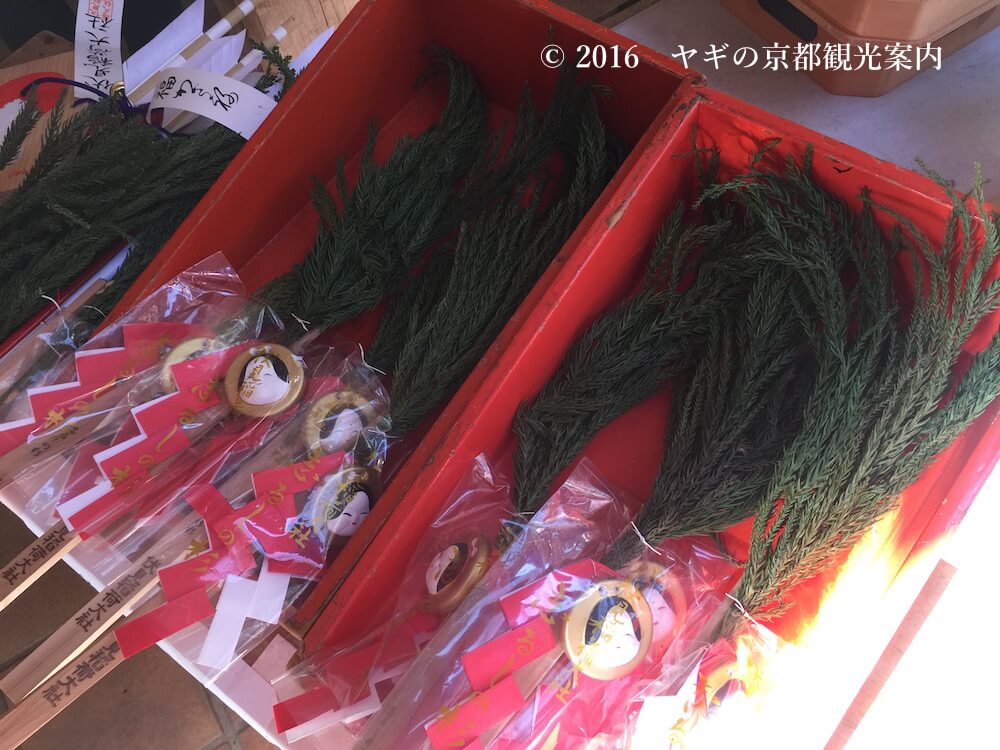
#1 means the veneration for ancestors、#2 and #3 means the faith on rice cultivating called “Koku Rei Shinko (穀霊信仰) , and #4 means Shirushi no Sugi (The twigs in the photo) available in Hatsu Uma Taisai (video).
Yamashiro no Kuni Fudoki doesn’t reveal when Fushimi Inari was established. Nijyu Ni Sha Chushiki (『二十二社註式』), the historical record of Shinto shrines tells us it was founded in 711.
As the Fudoki describes, Fushimi inari enshrined an anonymous Kami of rice cultivating in the beginning and she became considered as Uka no Mitama no Kami, a deity in Japanese mythology.
Uka no Mitiama and Fox 宇迦之御魂神とキツネさん
The relationship between Uka no Mitama and Fox

Before 7the century, aristocrats believed that white and black foxes brought them good luck but this concept ceased to exist soon.
Around the 8th century, a brand-new belief in Foxes was imported from ancient China and became popular among the aristocrats: White foxes were symbol of good fortune. And other ideas about foxes were also imported and fused with domestic folklores.
- White Foex 白狐・・・Shinshi of Inari shrine are usually this one.
- Ten Ko 天狐・・・Dakini Ten and Shgendo (The fusion of Shinto, Buddhism and Taoisum) gave birth to her.
- Ku Ko 空狐・・・Flying foxes. They serve for priestess with their own will.
- Ki Ko 気狐・・・Apprentice fox on the way to Ki Ko.
- Ya Ko 野狐・・・Foxes with bad attitude. They deceive and mislead people.
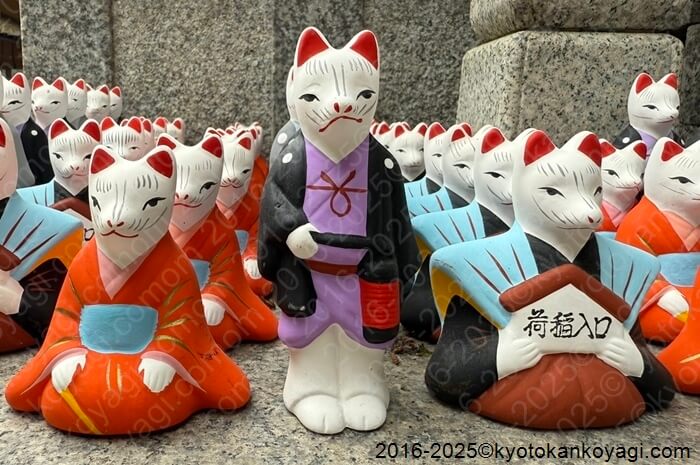
The foxes of Fushimi Inari are white ones and Shinshi (神使) who tell us the will of deity on behalf of her.
Uka no Mitama is also known as Miketsu Kami (Kami of food for deity). It is said Miketsu resembles Miketsune (Three foxes) and the facet implies the relationship between them but I suspect it is an excuse. There must be another story.
The common reasons for the relationship:
- Foxes often make den taking advantage of Kofun (Ancient burial place). She visit a place people live. The behavior reminds them of Sorei Shinko. Our ancestors believed the souls of their deceased antecedents stay in mountain and they visit them occasionally.
- Ancient people believed Kami of mountain visit rice paddies for rice cultivation. They thought foxes visit their places were messenger tell them her visit.
- They also believed the urine of foxes prevented pest animals from rice paddies.
In addition to it, Nihonkoku Genpo Zenaku Ryoiki (『日本国現報善悪霊異記』), the compilation of Buddhist stories in the 9th century, implies the relationship was familliar.
- A man met a fox pretended to be a lady. He married her. One day, she went into a facility for rice milling. A puppy followed her. She was so frightened she revealed herself. She left her husband. Mino Kitsune, a descendant of the couple, was a hulking mugger.
- Raijin (Kami of thunder) gave peasant a baby with a snake on his head. He became a monk of Gangoji temple (A famous temple in Nara) and he irrigated the wasteland to help rice cultivation.
I suppose the behavior of foxes (#1 and 2 in the first tips) and the implication of The faith of Dagon and Serpent (#2 in the second tips) played a critical role for the relationship. Generally speaking, the foxes in Inari shrines detest dogs. I suppose #1 in the second tips is one of the reasons.