THE GIST OF THIS ARTICLE
- Page 1 Who is Oinari-san?, The Deity Enshrined in Fushimi Inari Today, Veneration for Ancestors, Kannnabi, Faith of Dragon and Serpent, Innari no Ohkami: Mixture of Veneration and Faith of Rice Cultivating, Uka no Mitiama and Fox
- Page 2 Oinari-san and Dakini Ten, Dakini Ten, Oinari-san became popular, Goriyaku of Oinari-san, Bibliography
The following is the contents of this article.
Oinari-san and Dakini Ten お稲荷さんと荼枳尼天
Fushimi Inari met Toji temple 伏見稲荷大社と東寺

Dakini Ten is a guardian deity of Buddhism. The encounter between Fushimi Inari and Toji temple paved the way for developing of Dakini Ten (荼枳尼天) as Oinari-san.
In 827, Emperor Jyunna (淳和天皇) suffered from a serious illness. As a matter of practice of the time, Onyoh-Ryo ministry detected a cause through an oracle. Inari no Ohkami is upset because Toji temple cut down the trees in Mt. Inari for the construction of the pagoda. In order to calm her down, the emperor gave her one of the Imperial ranks and Fushimi Inari became a Chin Jyu Sha of Toji.
Chin Jyu Sha (鎮守社) is a guardian Shinto shrine of Buddhist temple. For example, Jisyu shrine is a Chin Jyu Sha of Kiyomizudera.
In 942, Emperor Suzaku () gave the teple Shoicii (正一位) Imperial ranking. We often see a banner saying, “正一位稲荷大明神” in Fushimiinari and other shrines or temples enshrine Oinari-san.
Inari Daimyojin Ruki (『稲荷大明神流記』), the report of Inari Daimyojin also known as Inari no Ohkami, depicts:
Kukai, the founder of Shingon school of Buddhism, encountered an old man who revealed that he is a deity. He said to the man that he would establish the esoteric Buddhism (later known as Shingon school) for the purpose of the prosperity of the country. He asked the man to meet again.
In 823, Emperor Jyunna gave a permission to run Toji temple to Kukai. The old man came up to the temple to see him. Then Kukai enshrined him in Mt. Inari.
This story is different from the one in Inari Daimyojin Ruki. It is believed that this one describes the relationship from the point of view of Toji.
In Inari Sai, Inari no Ohkami stayed in Otabisho located near Toji temple. Otabisho is a place the old man stayed and the Buddhist ritual held in front of the gate of Toji recreates the reunion of them.
There is another story in the report. Ryu Toh Ta (龍頭太), an ancestor of the priests of Fushimi Inari, met came across Kukai in Mt. Inari. Ryu Toh Ta said to him that he was a deity of the mountain and he would save Toji forever.
Ryu Toh Ta means a man with dragon head. This story emphasize the faith of dragon (and serpent).
Dakini Ten 荼枳尼天
Dakini Ten (荼枳尼天) is a guradian deity of Buddhism. She is an adopted deity indigenous to ancient India.
We can find her in Taizokai Mandala.
In India, Dkini Ten is called Dakini serves for kali, a deity of death and destruction. Dakini is a deity who can fly in the sky and eats humans.
In Dainichi Kyosho (『大日経疏』), the commentary of Dainichikyo sutra, describes how Dainichi Nyorai make her into a good deity. Birushana Butsu transformed into Daikoku Ten and asked her why she eats humans. She explained that there was nothing to eat except humans. Daikokuten said that he would gave her an ability to know the time of death of people and asked her to eat the dead body of them instead on living ones.
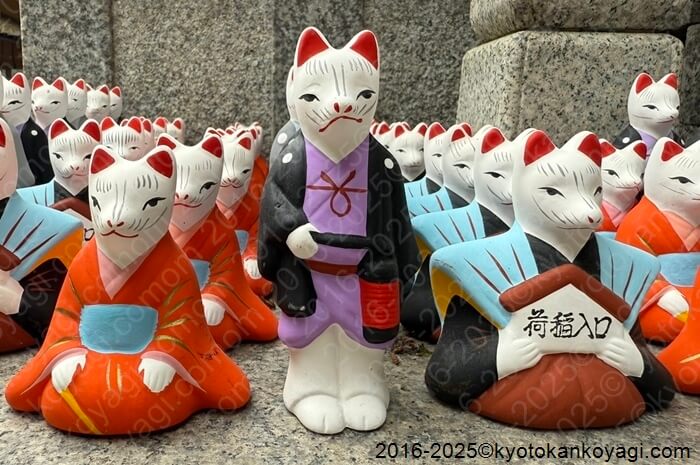
On the other hand, Jackal also eats dead body. When they are imported to Japan, Jackal became a Kenzoku (眷属) of Dakini Ten.

Kenzoku is an animal serves for a Buddhist deity.
There were no Jackals in Japan and fox played its role as a substitute. As a consequent, Dakini Ten is usually on a fox(es).
As stated before, Uka no Mitama has a relationship with fox and Dakini Ten has foxes as Kenzoku. I suspect fox played a critical role for Dakini Ten to became Oinrai-san.
Uga Jin and Dakini Ten 宇賀神と荼枳尼天


ぎゃあああああああ!!!!!
Uga Jin (宇賀神) is a deity not found in Japanese mythology. He is a deity of grains and an incarnation of serpent deity who gave us prosperity.

Tendai school adopted him and he was fused with Benzai Ten (弁財天) who also brings us prosperity.
As described, Dakini Ten used to be an evil deity. When she was adopted as a good deity, monks took advantage of the gentle appearance of Benzai Ten: Uga (宇賀) of Uga Jin and Uka (宇賀) of Uka no Mitama is the same in Kanji. Benzai Ten played an important role when Dakini Ten became Oinari-san. Actually, Dakini Ten was fused with Benzai Ten and Sho Den and enshrined in Aizenji temple in Fushimi Inari.
The way of the fusion:
- Oinari-san (Uka no Mitama) and Fox
- Dakini Ten and Fox
Thanks to Fox, Dakini Ten can be Oinari-san but Dakini Ten is an evil deity. It is demanding for her to be Oinari-san.
- Uga Jin resembles Uka no Mitama in Kanji.
- We can treat them as the same deity
- Namely, they are Oinari-san.
- Dakini Ten is also Oinari-san.
- She can has the same appearance as Benzai Ten.
The fusion was born around the 12th century.
Oinari-san became popular お稲荷さんが広まる
Goriyaku of Oinari-san お稲荷さんのご利益

Oriyaku is a blessing or benefit that Shinto and Buddhist deity gives to us. Oinari-san brings us numerous ones.
The faith of Oinrai-san is based on the faith on rice cultivating and the primal one is a success in rice cultivation and agriculture. The vitality of the diet (rice) makes us alive and the Goriyaku was broadened as time passed by. Prosperity in business, god health, safety of family, and so on.
In the 10th century, as the outstanding poetic diary called Kagero Nikki (『蜻蛉日記』) describes, Oinari-san was believed as an Aiho Shin (愛法神) deity of love.
In the 12th century, Taiki (『台記』), the diary of a court noble says that fox has goriyaku prevents us from fire. Dakini Ten was fused with Benzaiten (Deity of prosperity) and Bisha Mon Ten (Deity of victory) and Oinari-san also gained these Goriyaku.
As described, Dakini Ten has an ability to know when people die. Due to this, Somurai warriors believed Oinri-san as a deity of war. Actually, there usually is Inari shrine near castle.
This post is so long. Thanks for reading! お疲れ様でした。合掌
Bibliography 参考文献
- 山折哲雄/編(1999)『稲荷信仰事典』戎光祥出版
- 三好和義(2003)『伏見稲荷大社』淡交社
- 中村陽/監修(2009)『稲荷大神』戎光祥出版
- 大森恵子(2011)『稲荷信仰の世界 稲荷祭と神仏習合』慶友社
- 本多健一 (2015)『京都の神社と祭』中央公論社
- 中村 禎里(2017)『狐の日本史 古代・中世びとの祈りと呪術』戎光祥出版
- 井上満郎(2018)『お稲荷さんの正体 稲荷信仰と日本人』洋泉社
- 羽田守快 (2020)『荼枳尼天の秘密』